
MENU
- Home
- Okinawa Churashima Foundation Research Institute
- Studies of Marine Animals
- Research activity report
- Publication of a scientific paper on black sea turtles ingesting marine debris in the waters around Okinawa Main Island!

Research on marine organisms
Publication of a scientific paper on black sea turtles ingesting marine debris in the waters around Okinawa Main Island!
Man-made marine debris affects many marine animals, and has become a global problem. Man-made objects, when ingested by sea turtles, negatively impact their growth and survival. An understanding of the extent of this problem is important for sea turtle conservation around Okinawa Main Island.
From 1999 to 2023, we conducted the first quantitative survey of ingested marine debris in the Western Pacific, with the study of five black sea turtles. Three black sea turtles were found alive, cared for at Okinawa Churaumi Aquarium, and they excreted soft plastics and other artificial materials over 2 to 72 days. The other two black sea turtles were found deceased and washed ashore. Necropsies showed that one of these turtles had artificial objects in their digestive tract.
Of this sample, four of the five turtles (80%) had consumed man-made marine debris. This is a higher percentage than seen in other species of sea turtles inhabiting the same area. A higher rate of marine debris consumption, especially if caught in their digestive tracts, will cause a deterioration in health of the black sea turtle population. The researchers suggest that black sea turtles, when found in distress near Okinawa Main Island, should undergo emergency rescue to quickly remove artificial objects using medication and endoscopy.
For more information, please read the scientific paper below.
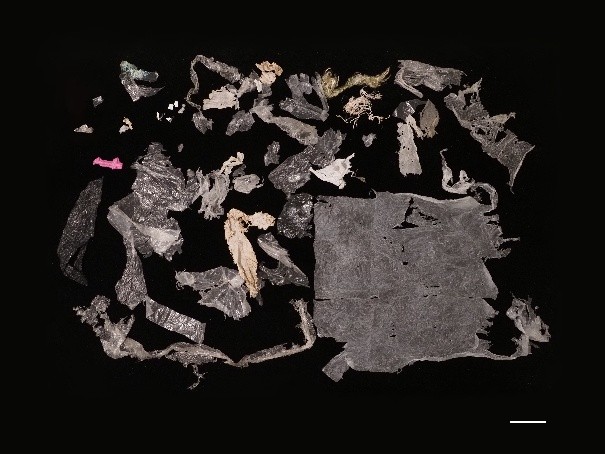
Artificial substances excreted from a black sea turtle (Length of scale line is 50 mm)
Author
Takahide Sasai・Kei Yamazaki・Ken Maeda・Kaho Mizuochi・Masakatsu Kino・Isao Kawazu
Title
Marine debris ingestion of black sea turtles Chelonia agassizii around Okinawajima Island, Japan
Journal
Umigame Newsletter of Japan
Link

Copyright (c) 2015 Okinawa Churashima Foundation. All right reserved.