
MENU
- Home
- Okinawa Churashima Foundation Research Institute
- Studies of Marine Animals
- Research activity report
- Scientific paper published on the world’s first large scale dataset of humpback whale photo identification

Research on marine organisms
Scientific paper published on the world’s first large scale dataset of humpback whale photo identification
Each humpback whale has flukes with a unique pattern and shape, this allows individual humpback whales to be identified. A scientific paper was published on the creation of a dataset of humpback whale fluke images from across the entire North Pacific Ocean, and the first ever development of an AI-based fluke matching system.
The humpback whale fluke identification photographs used in this research were collected and provided by 39 research organizations, aggregated into 13 regions (6 breeding grounds, 6 feeding regions, and 1 migratory corridor). These identification photographs were matched and aggregated using an AI-based automatic image recognition system to create the world’s first large scale dataset of humpback whale identification photographs. Between 2001 and 2021, 157,350 encounters resulted in the identification of 27,956 unique individuals. Analysis of the photographs showed that 87% of the humpback whales in the North Pacific Ocean were encountered in more than one season, and the average observation count was 5.6 times.
The large-scale data set, and the AI-based automatic image recognition system that was developed in this research is an extremely important technology and information source to plan for conservation and understanding the ecology of the humpback whales that migrate great distances across regions.
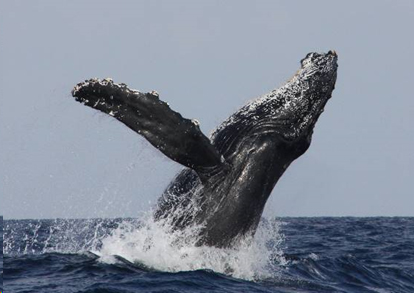
Humpback whale breaching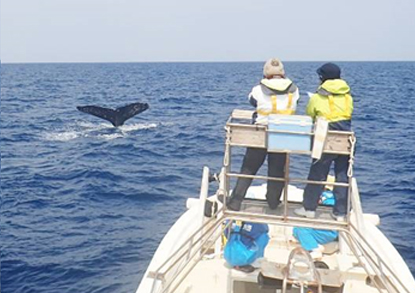
photographing flukes during a survey
Author
Ted Cheeseman, Ken Southerland, …, Nozomi Kobayashi, …, Haruna Okabe, …, Phil Clapham(and 64 other co-author)
Title
A collaborative and near‑comprehensive North Pacific humpback whale photo‑ID dataset
Journal
Scientific Reports
Link

Copyright (c) 2015 Okinawa Churashima Foundation. All right reserved.