
MENU
- Home
- Okinawa Churashima Foundation Research Institute
- Studies of Marine Animals
- Research activity report
- Scientific paper published concerning the local movements of humpback whales in Okinawan waters

Research on marine organisms
Scientific paper published concerning the local movements of humpback whales in Okinawan waters
Each year, from January to April, humpback whales migrate to breeding grounds in Okinawan waters. The Okinawa Churashima Foundation Research Center has been conducting surveys of humpback whales since 2006, both around the Kerama Islands, and off the coast of Motobu.
In this survey, we identified 496 individuals, by observing their behavior and using photo-identification. Photo-identification was achieved by analyzing the distinct shapes and patterns on the lower sides of humpback whale flukes.
We also studied the movements of individuals between the Kerama Islands and the waters off of Motobu. The humpback whales were categorized into three groups: male, female (no calf), and female with calf. The results show that of the whales which migrate to the waters of Okinawa, 20% are actively moving between the Kerama Islands and Motobu within the same season. The frequency of these movements between areas is significantly higher for males than females. Females with a calf tend to move less between these areas than males or females without a calf.
From these results, we speculate that males and females without a calf migrate to Okinawa to find more opportunities to mate and do this by frequently moving between the two sites. A female with calf will however migrate to Okinawa and then remain in the same area to give birth and devote themselves to nursing their calf.
Authors
Nozomi Kobayahsi, Haruna Okabe, Isao Kawazu, Naoto Higashi, Keisuke Kato, Hirokazu Miyahara, Gen Nakamura, Hidehiro Kato, Senzo Uchida (Bold letters:Foundation staff member)
Title
Distribution and Local Movement of Humpback Whales in Okinawan Waters Depend on Sex and Reproductive Status
Journal
Zoological Science
DOI
http://dx.doi.org/10.2108/zs160012
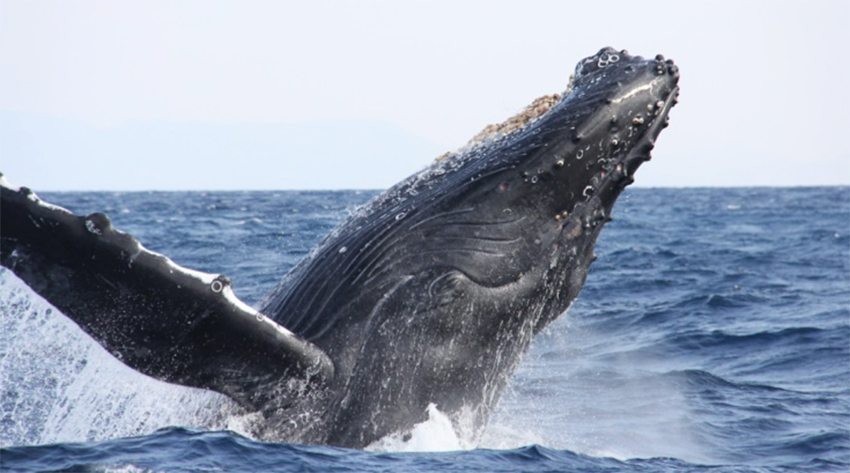
Humpback whale seen in waters of Okinawa Island

Copyright (c) 2015 Okinawa Churashima Foundation. All right reserved.