
MENU
- Home
- Okinawa Churashima Foundation Research Institute
- Studies of Marine Animals
- Research activity report
- The eggs from a mother turtle killed in a traffic accident were artificially incubated, hatched, and then released

Research on marine organisms
The eggs from a mother turtle killed in a traffic accident were artificially incubated, hatched, and then released
On the night of August 16th 2015, a sad accident occurred where a green turtle that landed on the shore of Kijyoka Ogimi Village in Okinawa to lay her eggs was struck by a vehicle on a road behind the sandy beach.
Around 11:00pm, we received a phone call from Mr. Kunio Komesu a member of council from the Sea Turtle Association of Japan reporting “a green turtle has been struck by a car.” We immediately left for the location. We arrived at the scene an hour after receiving the call but the green turtle was already dead. Parts of the internal organs plunged through its split carapace which was a horrible sight, however it seemed the turtle was still alive just before our arrival.
After tracing the tracks of the green turtle, it became clear that soon after landing on shore it proceeded straight toward the vegetation and through its gaps and entered the roadway without laying her eggs. This meant the eggs that should have been laid were still within the abdomen of the mother turtle. We supposed if there was no damage to the eggs within the abdomen then there was a good chance to hatch them, so we transported the carcass of the mother turtle to the integrated research center to conduct an autopsy.
Multiple eggs were found when we removed the plastron. As we continued the autopsy 80 eggs were found in the the oviducts and all were removed without harm. Carefully, these eggs were washed in fresh water trying not to agitate them, then placed in an incubator (a machine in which the eggs are hatched) in a temperature fixed at approximately 29℃ (A critical temperature so that the ratio of male and female offspring are the same), and over 90% of humidity in an attempt to artificially hatch the eggs.
On October 10th, 54 days after removing the eggs, a pip (the act of cracking the shell) was confirmed. This continued until October 14th a total of 58 days with the hatching of 20 baby turtles. After confirming the baby turtles are in a frenzy (excitement phase) they were released at night on the Kijyoka shore where their mother had the accident. In other words, the baby turtles were released and journeyed in to the ocean from the shore they were meant to be born on.
It is globally unusual to have succeeded in artificially hatching eggs that were removed from a body and furthermore it was delightful to have released them, however the most essential thing is to preserve the shore environment for sea turtles to peacefully lay their eggs. With lessons learned from this accident we hope measures are taken so that sea turtles do not enter roads with heavy traffic that are directly connected to shores.
(I. Kawazu, Division of Marine Biology)
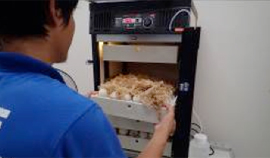
The incubator in use
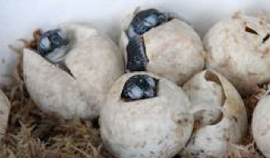
Baby turtle after pipping (cracking of the shell)
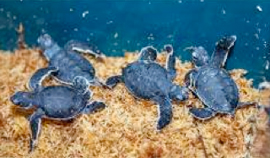
Baby turtles right before their release

Copyright (c) 2015 Okinawa Churashima Foundation. All right reserved.